Hand us the card
Your name, logo, colors, contact details, and first impression give us the starting signal.
Music · Video · Social
Hand it over. OGB Productions turns the name, colors, story, and energy behind your business into a tailored digital sample—then builds the full campaign around what connects.
We study your business before we cut a frame: the industry, the audience, the voice, and the details that make people choose you. What you see in the sample is what your customers should feel.
Your name, logo, colors, contact details, and first impression give us the starting signal.
We look at your trade, your audience, and the tone that fits the customers you want to reach.
Your first short teaser is tailored to the business—an honest look at the direction before a package begins.
Choose the route: branded teasers, complete production, or an ongoing content rhythm.
OGB brings the parts together so the message feels like one voice, not five vendors: sound, picture, brand, pacing, and platform.
A short, branded concept that puts your own identity on screen—built around your customers, not around a one-size-fits-all template.
Custom sound, production, and musical direction that give the message its own pulse.
Short-form concepts, promotional spots, edits, and story-led visuals built for attention.
Platform-ready cuts shaped for the places your audience already watches and listens.
A clear campaign idea, voice, and rollout so every piece works together.
$249 flat for up to 15 slides; slides 16–30 are $20 each, and slides 31+ are $15 each. Examples: 20 slides $349 · 30 slides $549 · 40 slides $699.
Music is where OGB learned to layer emotion, rhythm, and story. That same multitrack thinking now shapes every visual production.
Explore the Da Good Book set on SoundCloud and hear the production foundation OGB brings to the work.
Listen on SoundCloudAbout OGB
We’re OGB — a family-run media company out of Jacksonville, Florida.
Small businesses are here physically, but they’re not seen. No presence, or the wrong kind, or the kind they can’t afford. That’s the problem we solve.
How we work: You bring your business. We bring the camera, the pen, and the beat. Everything we make is built around you — your look, your sound, your story.
Who we are: Family. Brian and Sabrina create it, our network delivers it — music, animation, merch, and media under one roof. Angie serves the meal, we cook it, we all eat.
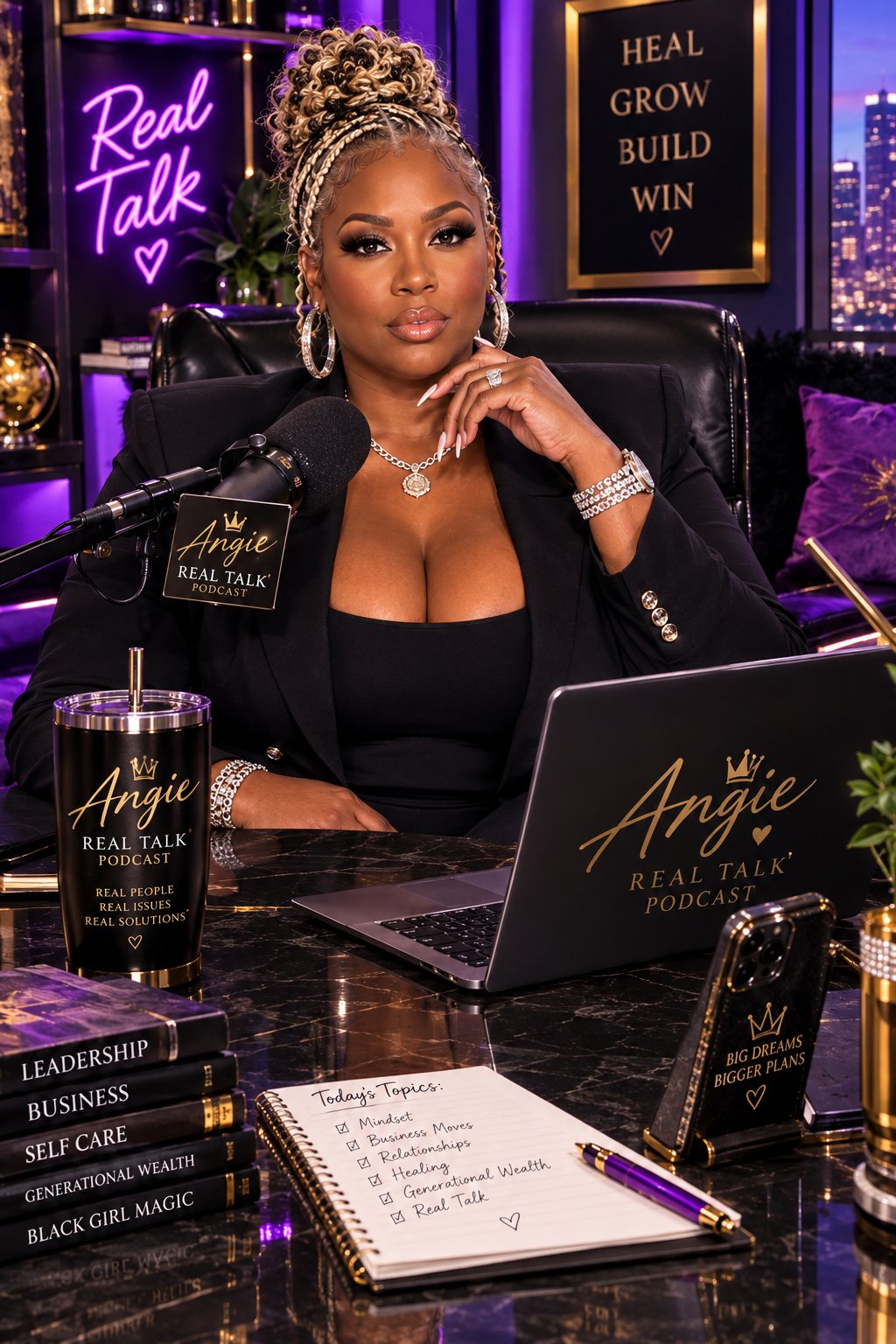
The voice and face of OGB
Angie serves the meal. Brian and Sabrina cook it. Everybody eats.
When He speaks, we move. Put OGB on the beat.
Four corners, one company. If this company scales, the square is the board.
“Videography isn’t much different from making a track.” Build the layers. Make it move.
Founded and led by Brian C. Coleman, OGB Productions is a Jacksonville music and media studio built on the craft of audio production and the discipline of telling a clear story.
The goal is simple: make the business sound like itself, look like itself, and stay with the audience after the screen goes dark.
Client welcome kit
Thank you for choosing OGB Productions. Here is everything you need to get started: who we are, how we work, what it costs, and the agreement that protects us both.
Our model is simple: Free is the beginning, never the business. We start with a sample so you can see the quality. Then we build the real thing together.
— Brian Coleman, Owner & Executive Producer
Start with a tailored sample. Choose the package that fits. Build a working content rhythm around the result.
A short sample of your content, on the house.
Your first paid package: teasers, branding, and strategy.
Complete production: video, music, social, and distribution.
Ongoing monthly content, priority turnaround, and locked-in rates.
It starts with your business card. Hand it over—we build your digital sample from it: your name, logo, colors, and contact details baked right into the cut. No generic templates.
The sample speaks your trade’s language—food, fitness, retail, services, whatever you do.
Your tone and your energy—not ours.
Cut for the customers you want walking through the door.
Sized and shaped for where you’ll post it—social, site, or screen.
This Name, Image and Likeness Agreement (“Agreement”) is entered into as of ____________________ (“Effective Date”), by and between:
TALENT: ________________________________________ (“Talent”)
COMPANY: OGB Productions, Jacksonville, Florida (“Company”)
Talent and Company agree as follows:
Talent grants Company the non-exclusive right to use Talent’s name, image, likeness, voice, and biographical information (“NIL”) in content produced by Company, including teasers, videos, music, social media, and promotional materials, in any media now known or later developed, worldwide.
The NIL grant covers only content produced under a project or retainer agreement between Talent and Company, plus Company’s own portfolio and promotional reels showcasing that work.
This Agreement begins on the Effective Date and continues for twelve (12) months, renewing automatically for successive twelve-month terms unless either party gives thirty (30) days’ written notice.
Compensation for the NIL grant is included in the project or package fees set out in the applicable Statement of Work. No separate NIL fee is due unless the parties agree in writing.
Company will not use Talent’s NIL in any context Talent has flagged in writing as off-limits. Talent will respond to approval requests within five (5) business days; silence after that period counts as approval.
Talent represents that Talent owns or controls the NIL granted here, is at least 18 years old (or a parent/guardian signs below), and has full authority to enter this Agreement.
Nothing here makes Talent an employee, agent, or partner of Company, and nothing here grants Company rights to Talent’s NIL beyond the Purpose in Section 2.
Either party may terminate with thirty (30) days’ written notice. Content already published before termination may remain in use; no new NIL uses begin after termination.
This Agreement is governed by the laws of the State of Florida.
This is the entire agreement on NIL between the parties for the covered projects, and it may only be changed in a signed writing.
Signature
Date
Print name
Signature
Date
Print name
Start with the complimentary sample, then choose the level of production and support that fits the work.
Choose a one-time production or build a monthly rhythm from the same menu.
A one-time animated introduction built around your business and brand.
$249 flat for up to 15 slides. Slides 16–30 are $20 each; slides 31+ are $15 each.
Examples: 20 slides $349 · 30 slides $549 · 40 slides $699.
Two revision rounds included. Slide count locked at signing.
Starter · $149/month: choose any 2 slots. Regular · $199/month: choose any 4 slots, or 1 premium item plus 2 standard items. Pick a fresh mix each month.
Commitment pricing: Starter $134.10/month for 6 months or $126.65/month for 12 months. Regular $179.10/month for 6 months or $169.15/month for 12 months.
Winter Pack · Spring Pack · Summer Pack · Fall Pack.
Four slots of seasonal-themed content per quarter.
30 seconds · $99 60 seconds · $149
Includes MP3, still-visual MP4, animated-visual MP4, and a commercial license.
Weekly briefing · Hosted by Angie
Every week, Angie looks back at what OGB Productions has built, then turns the desk toward the clients, opportunities, and next moves coming into view.
The work behind us. The road ahead. One clear briefing.
Latest episode
Angie's Sunday segment: OGB Enterprises LLC was filed with an EIN assigned, the FIN 2000 research paper was submitted early, the capstone manuscript merged with a pilot picked, and three key sends were verified.
Angie solo · Voice 4
Past episodes
Angie's Sunday segment: OGB registered ogbproductionsjax.com, the Enterprise card went live, all ten Da Good Book videos play on the site, and the tracker stands at thirty-two leads.
Angie solo · Voice 4
Angie's Sunday segment: the website went full storefront, pricing went airlock tight, Angie got locked in, and Monday's four-meeting blitz sets the week.
Angie solo · Voice 4
Dante Pettis said yes, the perfect square is locked in, payment rails are set, and the week ahead runs straight through Wednesday’s Flavorikan pitch.
Angie looks back on the day the team became real — onboarding paperwork, benefits-safe deals, the business structure — and maps the road to the founding client.
The site is live, the first client pitch is ready, the team is taking shape, and OGB is putting structure behind the creative engine.
Angie looks back on a fast week of building and lays out the route toward Flavorikan, team growth, clean business lanes, and a company that can keep moving.
The weekend on-ramp
During the weekend, one sharp moment from Angie’s desk becomes a social teaser. It brings people here for the full story—then shows them what OGB can build for their business.
The teaser is the invitation. The segment is the proof. The site starts the conversation.
Lead with one strong line, update, or reveal from the weekly desk.
Bring the social audience here to hear the full weekly briefing.
Turn OGB’s own campaign into a working example for the next client.
Music project · OGB Productions
Fourteen songs. Fourteen Bible verses. One body of work built from testimony, reflection, grace, and the hard road back.
14 × 14
Da Good Book pairs a fourteen-song catalog with fourteen Bible verses. The collection moves through confession, timing, work, mercy, forgiveness, and the straight-and-narrow road—each track carrying its own chapter of the larger testimony.
Three finished recordings currently housed with the project. Press play here, then visit the full SoundCloud set for the complete listening experience.
A personal release: forgiveness as peace, not permission.
Survival, calling, and gratitude set to music.
The flagship visual from the project, built frame by frame to the track.
The catalog is still being assembled. These are the confirmed titles, teasers, and project notes now on record—nothing filled in before the work is ready.
1 John 1:9 · Premiered August 15, 2026.
Boom bap / soul presentation.
Boom bap / soul presentation.
Gospel praise / reflective hip-hop.
Gospel praise / reflective hip-hop.
Gospel praise / reflective hip-hop.
Watch on YouTubeR&B / country-rap fusion. Final title pending.
Official music video from Da Good Book.
2 Thessalonians 3:10 · Official music video from Da Good Book.
Watch on YouTubePsalm 37:23 · Isaiah 6:8 · Official music video from Da Good Book.
Galatians 6:9 · Official music video from Da Good Book.
Ecclesiastes 10:19 · Official music video from Da Good Book.
Watch on YouTube2 Chronicles 25:9 · Official music video from Da Good Book.
Watch on YouTubeMatthew 11:28 · Official music video from Da Good Book.
Watch on YouTubeOfficial music video from Da Good Book.
The 60-second client cut of “Holy Hands,” made for Tramayne’s Wholely Hands practice.
Boom-bap mashup · 1 John 4:7–8 candidate.
The page grows with the record as each chapter is confirmed.
Follow the full set as the remaining chapters, verses, and visuals take their place.
Listen on SoundCloudTruck Manager – 2026 · Business capstone
A management simulation treated as a compressed business laboratory—and a decision case built for operators, professors, and students.
About the case
Brian C. Coleman founded OGB Logistics LLC on September 7, 2026, in Jacksonville, North Carolina — the wrong Jacksonville. He bought the wrong city, learned the 400-kilometer rule the hard way, sold it at a $68,000 loss, and started over. What followed was one of the most disciplined small-network builds in the simulation's history: 22 terminals across ten states, a debt-free balance sheet, a 94% reported operating margin, and a 1,000-credit IPO buy-in completed on self-financed capital. The house rule never changed: if cash can't get it, OGB won't get it.
Brian is a Business Administration major at Florida State College at Jacksonville, concentrating in entrepreneurship. His path runs from marketing (Temple University, Rowan College) to audio production (Full Sail University) to nearly a decade running OGB Productions. The OGB Logistics case study is his 14-week business capstone: a management simulation treated as a compressed business laboratory, where every decision is documented, every figure reconciled to evidence, and every recommendation tested against scenarios before it is made.
The study tells one causal story — how disciplined network design, continuous asset utilization, and demand-led expansion converted a temporary launch advantage into durable, self-financed growth and IPO readiness on the NASE Growth exchange.
Business operators will recognize the operating doctrines. Professors will find a teachable decision case with a clean evidence trail. Students will find a blueprint they can run themselves — and keep.
OGB Logistics LLC
A 14-week business capstone charter and evidence-reconciled case foundation
Five material developments since the September 21 baseline change the case foundation. Figures are labeled by source; screenshot readings are marked as such and remain subject to final reconciliation. The September 21 baseline is preserved below as the planning record; where it conflicts with this section, this section governs.
On September 24, 2026, OGB closed the Columbus Spur. Columbus, OH joined the network as the 22nd owned terminal, designated Tier 3 Regional, at an acquisition cost of approximately $317,000 + 44 credits — consistent with the September 21 plan. The westward Keystone extension has moved from planned to owned. Tier 3 now counts five terminals: Pittsburgh, Harrisburg, Savannah, Alexandria, and Columbus.
The September 30 fleet count is 52 vehicles: 29 box vans, 18 rigid trucks, and 5 tractors with 5 semi-trailers. Maintenance was clean at last check — zero units at or above the 50% wear threshold and zero MOT items due within three days.
Public trading began September 22 on the NASE Growth exchange. October 1 screenshot readings (pending reconciliation): liquid cash approximately $17.08M, market capitalization approximately $39.8M, share price $51.18 (+15% on the week).
On October 1, management adopted a standing hub-allocation protocol for the Pittsburgh and Columbus hubs, resolving the capacity-planning debate under demand uncertainty. The protocol is a base-stock (par-level) inventory policy: twelve units deploy at the computed equilibrium (4 electric box vans + 2 rigid trucks per hub); a 2-unit standby reserve is held and replenished on each deployment; the par level is reviewed approximately every 15 days as observed demand moves. Estimated procurement is approximately $2.85M against current dealer prices, subject to reconciliation. The protocol stands until further notice.
On September 26, management committed to a 50%-green fleet within 60 real days (deadline: November 25, 2026). The approved implementation is a phased 17-vehicle all-electric procurement — nine units for Pittsburgh (est. ~$2.82M), eight for Columbus as demand is confirmed (est. ~$2.51M), approximately $5.33M total — funded from operating cash within the standing 50% cash-floor rule. No purchase had been executed as of October 1.
The Gulf Spur (Tallahassee → Mobile → Biloxi → New Orleans → Baton Rouge) planning estimate is refined to approximately $561,000 + 122 credits. Sequencing follows the Columbus decision.
This capstone would treat Truck Manager – 2026 as a business simulation and OGB Logistics LLC as the case. The value is not the speed of the playthrough alone. It is the visible chain of choices: where to place capacity, how to keep assets moving, when to spend scarce credits, how to use contracts to test markets, and whether the firm is truly ready for an initial public offering (IPO).
| Metric | In-game snapshot | Capstone use |
|---|---|---|
| Founded | Sept. 7, 2026 | Baseline |
| Fleet | 50 trucks | Capacity |
| Network | 21 terminals / 10 states | Scale |
| Equity | $15.0M | Valuation |
| Liquid cash | $4.336M | Liquidity |
| Debt | $0 reported | Leverage |
| Organic revenue | $287k–$344k/day | Earnings |
| Profit margin | 94% reported | Efficiency |
Evidence note: Brian supplied these in-game figures through dated status reports on September 18–21, 2026. The September 19 snapshot records $15.0M equity, $4.336M liquidity, and 50 deployed vehicles. The 1,000-credit IPO buy-in completed on September 21, moving the company into the pre-IPO phase. The final academic submission should reconcile each figure to screenshots or exported statements.
How did OGB Logistics convert a seven-day subsidy and four-times-speed launch period into a debt-free, high-margin network, and which post-IPO expansion strategy best preserves that advantage?
The capstone should first reconstruct what happened, then diagnose why it happened, and only then recommend what OGB should do next. That sequence limits hindsight bias and gives the finance work a factual base.
| Week | Decision focus | Concrete output |
|---|---|---|
| 1 | Charter and rubric | Lock the problem, audience, outputs, and academic requirements. |
| 2 | Evidence inventory | Collect screenshots, P&Ls, checklist states, costs, and status reports. |
| 3 | Decision chronology | Rebuild the sequence from founding through IPO readiness. |
| 4 | Network analysis | Map hubs, tiers, loops, spines, service regions, and bottlenecks. |
| 5 | Operations analysis | Study dispatch cadence, utilization, maintenance, fuel, and management boosts. |
| 6 | Economic diagnosis | Separate subsidy effects from organic performance; analyze trade-offs. |
| 7 | Financial baseline | Reconcile income, cash, equity, debt, assets, and recurring costs. |
| 8 | Capital budgeting | Model Columbus, the Gulf Spur, reservoir expansion, and alternatives. |
| 9 | Scenario design | Build downside, base, and upside cases for growth and fuel volatility. |
| 10 | Strategic choice | Select the post-IPO sequence and define decision gates. |
| 11 | Risk and controls | Add triggers for liquidity, maintenance, fuel, contracts, and execution. |
| 12 | Full draft | Write the case, analysis, recommendation, and exhibits. |
| 13 | Challenge and revise | Test assumptions, reconcile numbers, and tighten the argument. |
| 14 | Defense package | Finish the paper, executive brief, slides, and speaking notes. |
OGB does not merely own 21 terminals. It organizes them as a functional pyramid in which each tier defines what a location can do, while dedicated box-van hubs extend service into markets that are too small to justify ownership.
Jacksonville and Savannah followed the same incremental doctrine: acquire the location at a manageable base price, then promote it when its network role justifies the additional capital. The ledger records upgrade outlays separately so the capstone can distinguish location acquisition from capability expansion.
| Terminal | Base purchase | Upgrade | Total invested |
|---|---|---|---|
| Jacksonville, FL | $168k + 10 cr | $23k Regional (Sept. 7); Continental ~Sept. 16 | $828k |
| Savannah, GA | $102k + 10 cr | $30k to Tier 3 (Sept. 7) | $132k |
| Dover, DE | $104k + 20 cr | $35k Regional (Sept. 9); $632k Continental (Sept. 11); $56k Global (Sept. 12) | $827k + 20 cr |
These are served micro-markets, not additional owned terminals, so the 21-terminal count does not change. The model extends the donut doctrine: owned infrastructure provides the line-haul backbone, while unowned small markets are served at marginal cost.
OGB uses one-time long-haul contracts as market probes before committing permanent capital. Columbus was the first successful probe; Baton Rouge was the second. Both contracts were completed, and Baton Rouge produced a $25k payout. The record is now two tests and two validated expansion directions.
The Columbus bid closed about eighteen hours after Dover’s September 11 Continental promotion — the bid qualification bought against a deadline. The run went in two waves: a five-reefer convoy, then a three-reefer convoy to close it out — twenty hours round trip, done early in about two days. Brian: “you never forget your first time.”
| Bid | Run direct | Measure | Decide | Build |
|---|
Demand signal → operating proof → financial evidence → investment gate → permanent network
Columbus and New Orleans can become the fourth and fifth dedicated box-van hubs only if the post-IPO fleet can absorb both the new corridor equipment and the in-city work. Terminal tier, van allocation, route density, and one-Big-Stick-per-corridor capacity will therefore be decided together after the IPO. Until that overlay is complete, both hub designations remain planned rather than operational.
| Decision | Known cost | Analysis required |
|---|---|---|
| Columbus Spur | $317k + 44 credits | Sequence the westward Keystone extension after IPO. |
| Gulf Spur | $561k + 132 credits | Model the five-city build and Baton Rouge demand. |
| Fleet overlay | TBD after IPO | Size Big Sticks, box vans, and local-hub capacity together. |
| IPO | 1,000 credits | Buy-in complete Sept. 21; pre-IPO phase — preserve the cash floor through listing. |
The strongest capstone will separate what the game shows, what Brian decided, and what the analysis later infers. A dated evidence register makes that distinction visible.
| Evidence stream | Capture consistently |
|---|---|
| Financial | P&Ls, equity, liquid cash, debt, fuel spend, maintenance, terminal costs |
| Operational | Truck count and mix, dispatch logs, utilization, downtime, turnaround rhythm |
| Network | Terminal acquisitions, relocations, tier upgrades, routes, loops, and capacity |
| Contracts | Bid amount, competitors, win/loss, cargo, duration, payout, backhaul results |
| Management | Four executives, team-member slots, levels, training spend, percentage boosts |
| IPO | Checklist snapshots, credit balance, reservoir state, buy-in, reward confirmation |
| Decision record | What was known, alternatives considered, choice made, result observed |
Brian supplied a Gemini-prepared reconstruction on September 18, 2026. It confirms the broad chronology and operating model, but it also reveals where the record still needs primary evidence or reconciliation before academic submission.
| Date | Event | Analytical meaning |
|---|---|---|
| Sept. 7 | OGB founded; launch support begins | Initial condition |
| Sept. 7–12 | 21 terminals acquired in six days; $2.554M + 440 credits | Rapid expansion; COO-led |
| Sept. 10 | One-day Sunshine blitz; wrong Jacksonville sold ($68k loss) | Deadline sprint; load-bearing mistake closed |
| Sept. 11 | Dover → Continental ($632k); Columbus bid closes 18 hours later | Bid qualification against a deadline |
| Sept. 11–12 | Cord cut; triangle bought from the $2M floor; CFO implements the hard floor | First organic acquisition; foresight, not reaction |
| Sept. 14 | Subsidy expires after the 200-credit extension is refused | The chosen cliff — capital allocation |
| Sept. 20 | $15.3M equity; $4.389M cash; 849 of 1,000 credits | IPO sprint: ~151 to go |
| Sept. 21 | Vault 1,000/1,000; pre-IPO phase; $18.8M market cap; $24.13 open; ~$9.74M cash | Buy-in complete; public trading expected ~3 PM Sept. 22 |
The daily series is strictly operational income from running trucks. Treasury injections, the $2M intermittent bonus, and other balance-sheet windfalls are excluded. The launch subsidy’s two-times earnings effect remains inside the operating series because it was earned through dispatched work.
On the morning of September 21 the entire 50-truck fleet sat idle at terminals: Big Stick 1 had completed maintenance at 0.0% wear, freight was visible on the map, drivers were present, and nothing moved — a dispatch failure in CTO Grant Nelson’s lane. Midday status reports showed cash moving from $4.523M to $4.6615M and equity from $15.4M to $15.5M, with $56K of R&D spend (allowed under the CapEx freeze) and a 96% reported margin. After the recovery order, all 50 trucks were reported moving within about two minutes; the post-recovery fleet health check showed zero vehicles in maintenance and four vehicles in their 40s on the 50%-trigger watch list. By evening the dashboard showed roughly $9.74M cash, $18.8M equity, 50 active vehicles with zero idle and zero in maintenance, and 520 credits — the cash move is consistent (inference) with the reported $5M IPO capital injection plus operating receipts, pending an itemized ledger.
All 21 terminals were acquired in six days, September 7–12, 2026, for $2.554M cash + 440 credits (acquisitions only; upgrades excluded; the sold Jacksonville, NC excluded). Columbus and Baton Rouge remain contract markets and future builds, not owned terminals. Dates marked * are Brian-confirmed windows; exact days remain TBD.
| # | Terminal | Date | Cash + credits | Notes |
|---|---|---|---|---|
| 1 | Newport News, VA | Sept. 7 | $104k + 10 cr | Rescue purchase; founding six |
| 2 | Jacksonville, FL | Sept. 7 | $168k + 10 cr | +$23k Regional same day; Continental ~Sept. 16 |
| 3 | Savannah, GA | Sept. 7 | $102k + 10 cr | +$30k Regional same day |
| 4 | Rock Hill, SC | Sept. 7 | $94k + 10 cr | Founding six |
| 5 | Burlington, NC | Sept. 7 | $98k + 10 cr | Founding six |
| 6 | Myrtle Beach, SC | Sept. 8 | $124k + 10 cr | — |
| 7 | Greenville, NC | Sept. 9 | $121k + 20 cr | Roster replacement for JAX NC (Sept. 10); same day as Dover |
| 8 | Dover, DE | Sept. 9 | $104k + 20 cr | +$35k Reg (Sept. 9); $632k Cont (Sept. 11); $56k Global (Sept. 12) |
| 9 | Alexandria, VA | Sept. 9 | $127k + 20 cr | Same day as Dover; elevated to Regional Sept. 19 |
| 10 | Wilmington, NC | Sept. 9–10* | $102k + 20 cr | Shored up the coastal spine |
| 11 | Macon, GA | Sept. 9–10* | $104k + 20 cr | Georgia Connector |
| 12 | Tallahassee, FL | Sept. 9–10* | $102k + 20 cr | Georgia Connector; Sunshine anchor |
| 13 | Athens, GA | Sept. 9–10* | $97k + 20 cr | Georgia Connector |
| 14 | Ocala, FL | Sept. 10 (Day 4) | $97k + 30 cr | First of blitz; JAX–Tallahassee bridge |
| 15 | Sarasota, FL | Sept. 10 | $124k + 30 cr | Blitz |
| 16 | Lakeland, FL | Sept. 10 | $102k + 30 cr | Blitz |
| 17 | Miami Gardens, FL | Sept. 10 | $109k + 30 cr | Blitz |
| 18 | Deltona, FL | Sept. 10 | $110k + 30 cr | Hail Mary; sealed the loop |
| 19 | Harrisburg, PA | Sept. 11–12* | $124k + 40 cr | Triangle; confirmed third city |
| 20 | Pittsburgh, PA | Sept. 11–12* | $317k + 40 cr | Triangle; only doctrine deviation |
| 21 | Atlantic City, NJ | Sept. 11–12* | $124k + 10 cr | Mayor’s 30cr discount; final buy |
A model-by-model audit resolves the earlier fuel-type discrepancy and connects route design, asset condition, acquisition cost, and current resale value. The verified fleet is 43 diesel vehicles and seven electric vehicles—not the preliminary 42/8 split.
| Class | Count | Operating role | Current value |
|---|---|---|---|
| Semis / “Big Sticks” | 3 | Twin spines / long haul | $549k |
| Rigid box trucks | 18 | Regional / cold chain | $1.217M |
| Box vans | 29 | Local loops / web | $1.195M |
| Total fleet | 50 | 43 diesel / 7 electric | $2.961M |
OGB began with a used fleet. On September 14, the day launch support expired, it sold five panel vans at $37k each and one rigid reefer for $57k, producing $242k in disposal proceeds. The panel vans were replaced with new box vans; only the old Eurohaul and classic Cartworth remain from the original fleet.
OGB operates with five executive chairs, including the Chief Executive Officer (CEO), and seven staff members under the four functional chiefs. In OGB’s structure, CTO means Chief Transportation Officer. The app does not name staff; the names below are illustrative identifiers for readability, while the roles, wages, reporting lines, and totals are game data supplied by Brian.
| Executive | Level / capability | Direct reports | Daily wage |
|---|---|---|---|
| CEO Brian | Lv 19 / command | Four chiefs | — |
| COO Harold Barnes | Lv 25 / +10 fleet | Maria Santos; James Park (HR) | $463 |
| CMO Frederick Garcia | Lv 18 / long haul | Kevin Reynolds (Networking) | $366 |
| CTO Grant Nelson | Lv 25 / faster turns | Lisa Chen (Engineering); Marcus Thompson (Technology) | $463 |
| CFO Robert Williams | Lv 33 / +2.9% cargo | Sarah Mitchell; David Okafor (Legal) | $592 |
| Path | Requirement | Opportunity cost |
|---|---|---|
| Premium currency | 65 credits | Delays IPO fund |
| Rewarded ads | 132 gallons at 4 gallons per ad = 33 ads | Uses time/attention; preserves credits |
The fuel-reservoir requirement is now green at 793 gallons. Diesel and electric prices still fluctuate, the dashboard reports consumption, and alerts appear at dangerously low levels. OGB’s policy is to buy on price dips while never allowing reserves to reach zero; the earlier ad-versus-credit choice remains useful evidence of disciplined premium-currency allocation.
The last funding gate fell on September 21: the vault reached 1,000 of 1,000 credits and the company entered the pre-IPO phase on the NASE Growth exchange. The listing snapshot showed an $18.8M market capitalization and a $24.13 opening share price, with public trading expected around 3:00 PM on September 22 and bidding open during the pre-IPO window. All operating prerequisites have been green since September 18; bonuses remain blessings, not strategy, and are never counted as operating performance.
| Credit item | Amount | Status |
|---|---|---|
| Final balance | 1,000 | Buy-in completed Sept. 21 |
| IPO requirement | 1,000 | Required buy-in |
| Remaining gap | 0 | Buy-in complete |
| Typical organic pace | ~60–65/day | Minus delivery, maintenance, and fleet burn |
| Listing status | Pre-IPO phase | NASE Growth; $18.8M cap; $24.13 open; public trading expected ~3 PM Sept. 22 |
| Energy alternative | 33 ads | Avoids 65-credit spend |
| Reported IPO reward | +500 credits | Confirm after listing |
| Reported cash reward | +$5M | Confirm after listing |
| Reported fleet capacity | +10 slots | Confirm after listing |
This checklist status is reconstructed from Brian’s dated reports; archive the in-game checklist screenshot before the final academic submission.
Checklist #12 opened after the buy-in at 44% (4/9 tasks). The visible tasks: own a concept truck (R&D Facility), run 48/50 marketing campaigns, depart 2,705 of 5,000 vehicles, complete 50 R&D projects, and train a staff member to level 42 — with CFO Williams (level 33 → 42) the designated candidate. On September 21 the CEO approved a standing policy: Raye and Bolt own company-checklist tracking, each new checklist gets a responsibility-and-action map with an accountable executive per task, and the executives own execution. Checklist discipline now sits alongside the 50% maintenance protocol and the cash floor as a named operating doctrine.
Credits are operating currency at OGB — spent on terminal acquisitions, Big Stick delivery and transport, maintenance, and fleet expansion — not just IPO fuel. The vault’s history is audited end to end.
The fleet ledger, management economics, operating revenue series, and terminal hierarchy are now reconciled. The remaining work is narrower and collectible.
| Market test | Current evidence | Decision role |
|---|---|---|
| Columbus, OH | First long-haul completed; $317k + 44-credit spur | Westward Keystone extension |
| Baton Rouge, LA | Second long-haul completed; $25k payout | Gulf demand validated |
| Gulf Spur | $561k + 132 credits; five-city path | Post-IPO permanent build |
The final paper should read as a decision case, not a tour of game features. Each chapter should advance the argument from temporary launch advantage to durable operating capability, then test whether the next growth move protects that capability.
| Settled direction | Confirm before submission |
|---|---|
| Simulation case study | Course rubric and faculty approval |
| Backward-then-forward arc | Final research method language |
| Network and operations focus | Complete dated chronology |
| Finance and PM integration | Complete cost-category detail |
| Contract-led growth thesis | Acquisition chronology #1–21 (closed) |
| Credit and floor doctrines | Credit journey; $2M floor origin (CFO, ~Sept. 11–12) |
| 14-week work plan | Faculty approval of topic and scope |
Next move: preserve the evidence now. The story can mature through fall finance and spring capstone, but screenshots and dated decisions are most valuable while they are still fresh.